


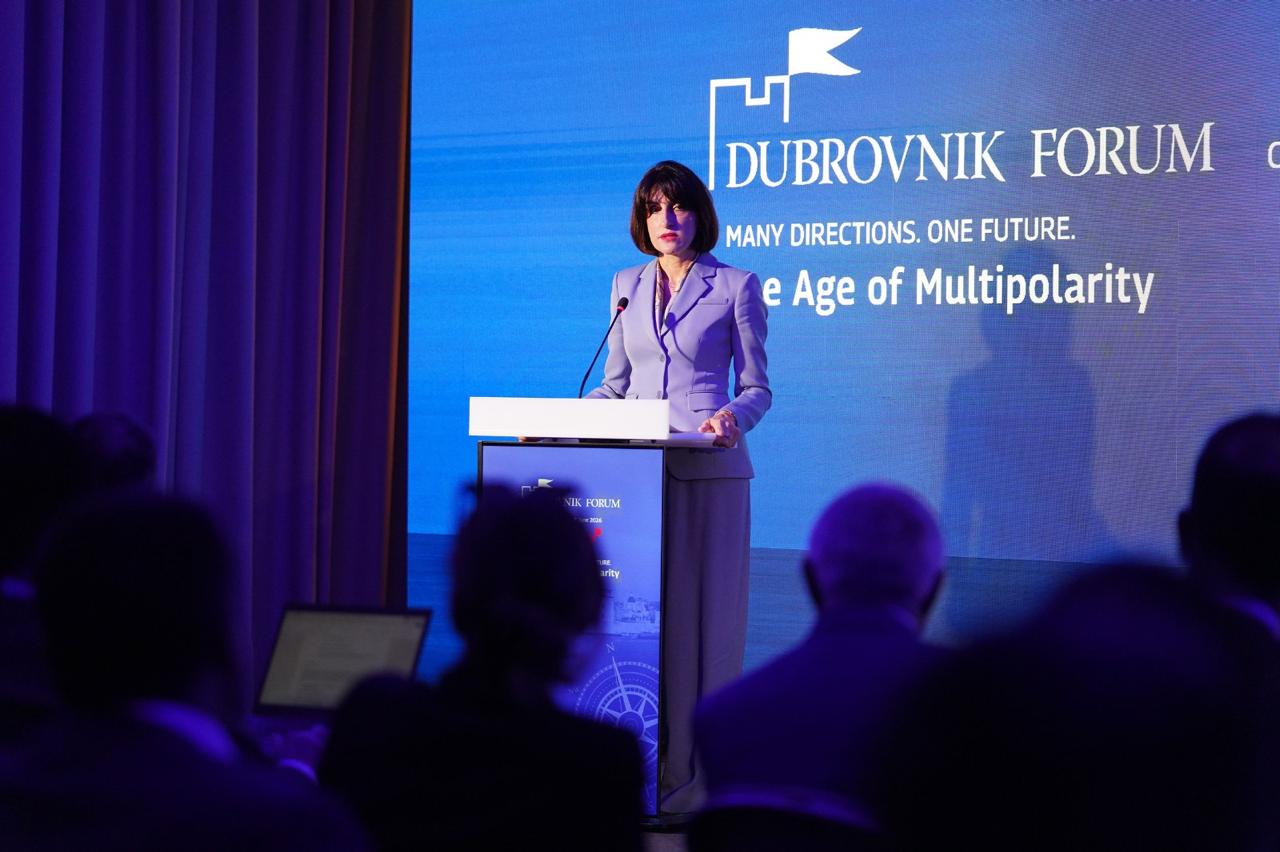
Statement of the Deputy Prime Minister, Minister for Foreign Affairs of Georgia, Maka Botchorishvili, at the panel discussion of the Dubrovnik Forum entitled “Between Power Centres: Lessons from Multi-Vector Diplomacy”
Excellencies,
Ladies and gentlemen,
It is a great honour to address you at the Dubrovnik Forum.
First and foremost, I would like to express my sincere gratitude to Minister for Foreign Affairs of Croatia, my dear friend Gordan Grlić Radman for his kind invitation and for providing this valuable opportunity to contribute to such an important and timely discussion.
This beautiful city, with its rich history, openness and resilience, is the perfect place to reflect on the changing dynamics of international politics and the role of multi-vector diplomacy in today's geopolitical landscape.
We often speak about a changing world, global transformations and the emergence of new centers of power as if we were merely observers. In reality, we are all participants in them. The decisions we make today shape not only the future of our own countries, but also the international order that is formed before our eyes.
That is why I believe Georgia is one of the strongest examples of what multi-vector diplomacy means in practice. Our history, our geography, our security environment and our economic interests require us to strike the right balance every day between principles and pragmatism, between openness and security, between national interests and international cooperation.
Georgia truly stands at a crossroads. Around us, different powers, competing visions, interests and strategic ambitions converge. Living in such an environment requires prudence, precision and responsibility. Our geography has gifted us with many challenges throughout history. But it has also taught us how to face them without letting them stand in the way of opportunities.
Today, as centers of power multiply and economic competition increasingly shapes international politics, the role of countries that connect rather than divide has become more important than ever. That is precisely the role Georgia plays today.
As the world searches for new trade routes and resilient supply chains become an essential element of global security, Georgia's geographic location has acquired renewed strategic importance. The Middle Corridor is no longer just a transport route. It is an emerging geo-economic corridor connecting Europe, the South Caucasus, Central Asia and the East. It is a space where trade, energy, digital connectivity, innovation, shared opportunities and common interests come together. Georgia's ambition is not simply to be part of this process because of its geography, but to be a reliable, predictable and responsible partner.
We should never forget that no economic project can succeed without peace and security. A country with 20% of its territory under Russian occupation advocates for peace more than most not out of weakness, but because it knows the true value of peace better than anyone else. That is why ensuring stability remains one of the highest priorities of Georgia's domestic and foreign policy.
Peace is the foundation of development. It is peace, together with macroeconomic stability and consistent economic policies, that has enabled Georgia to become one of the fastest-growing economies in Europe and the wider region, around nine percent annual economic growth in recent years.
Strong economic growth, record tourism, expanding exports, rising foreign investment and a business-friendly environment demonstrate that peace and stability translate into economic success. We are investing in modern infrastructure, expanding our ports, upgrading rail and road connections, and developing energy and digital infrastructure that strengthens the competitiveness of the entire region.
At the same time, our foreign policy is guided by a simple but important principle. For us, multi-vector diplomacy does not mean choosing between partners. It means building more partnerships. We are deepening cooperation with Central Asia, strengthening ties across the Black Sea region, and expanding our economic engagement with the Middle East and Asia.
Georgia has free trade agreements with some of the world's largest markets, creating a unique opportunity for our country to serve as an economic, investment and logistics platform connecting different regions and economies.
Georgia's multi-vector foreign policy has never meant and does not mean any ambiguity about our strategic choice. For us, Europe is far more than a political or economic union. It is a community of values. That is why integration into the European Union remains Georgia's firm strategic choice.
At the same time, we believe that a stronger Europe is built through openness, connectivity and a broad network of trusted partners. Georgia stands ready to contribute to that vision.
Brussels’ attempt to respond to Georgia with a policy of ignorance and isolation towards a country that is vital for Europe’s connectivity and has been a reliable partner for many years is not only unfair but also a strategic mistake.
Ladies and gentlemen,
Throughout history, moments of profound change have always tested the wisdom, courage and vision of nations. The world does not move forward when challenges disappear; it moves forward once societies find ways to overcome them together.
In such times, dialogue is not a choice it is a necessity. And cooperation is not simply an aspiration it is the foundation upon which lasting peace, stability and progress are built. We believe that, in today's world, success belongs to those who remain open, competitive and reliable.
Thank you.