


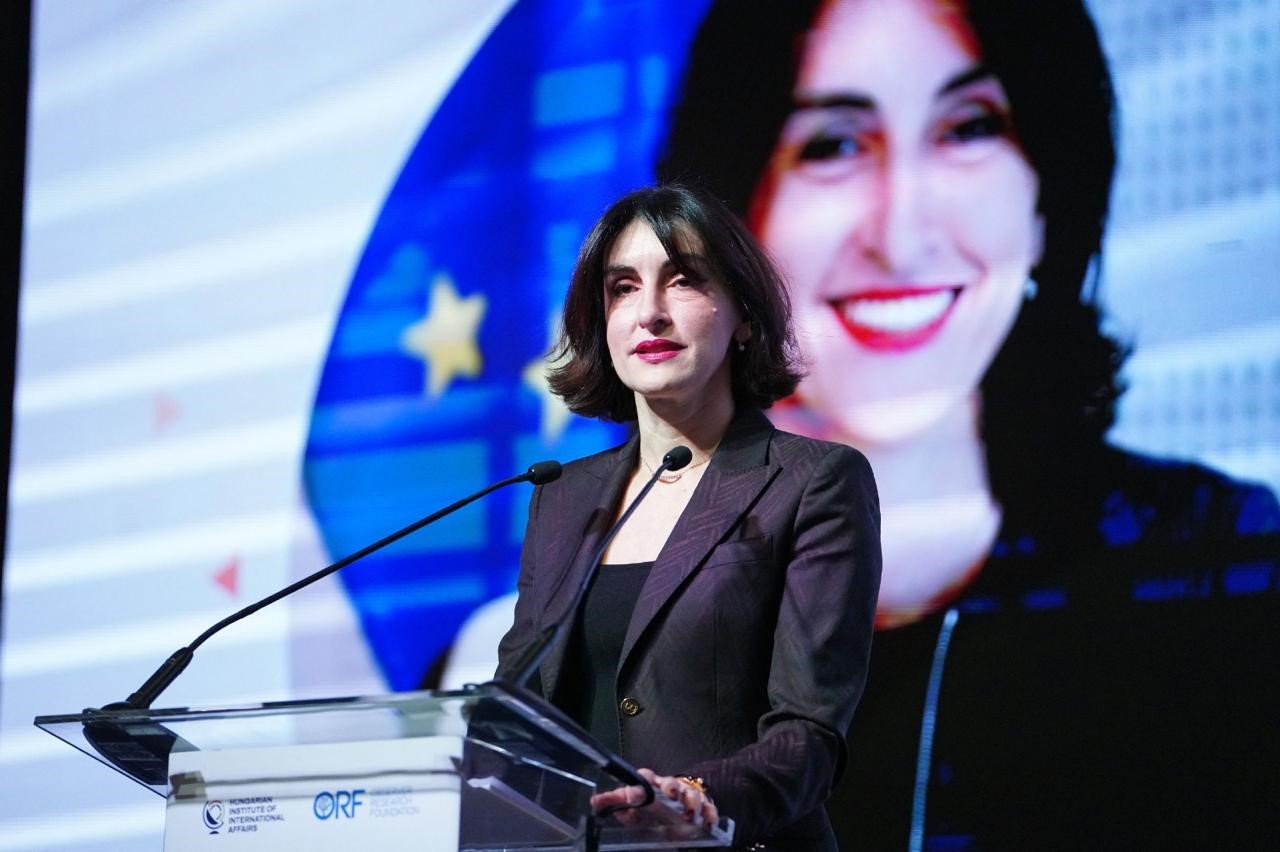
The Minister for Foreign Affairs of Georgia has delivered an address to the participants of the Budapest Global Dialogue
Distinguished guests,
Ladies and Gentlemen,
It is a great honor to join you in Budapest for the third Global Dialogue. I thank our Hungarian hosts and the organizers for creating a space where open conversation and strategic thinking is welcomed and encouraged.
The erosion of the global order and the growing spread of hybrid threats have made today’s security environment increasingly complex.
I represent a nation that understands the true value of peace, having endured the devastating consequences of war time and again. I represent a government that, amid an exceptionally challenging geopolitical landscape, has placed the defense of national sovereignty at the very heart of its policy. Georgia is an ancient nation that has survived centuries of turmoil by preserving its Christian and traditional values, and that continues today to defend these principles with resolve and conviction.
In today’s challenging environment, the concept of sovereignty has reemerged at the center of political debate in different parts of the world. Sovereignty is not about isolation or rejecting cooperation. It is about responsibility. It is about the right - and the duty - of nations to make decisions based on their own history, their own interests, and the democratic will of their citizens. Without this foundation, no security architecture can be sustainable.
In recent years, Georgia has been placed under unprecedented international scrutiny. We have endured deliberate and unjust attacks - conducted under the claimed defense of democracy - yet directed against the will of the Georgian people, their elected government, and the legitimate actions of the state. We have clearly seen how international institutions, and even our genuine European aspirations, can at times be misused as instruments to exert pressure on sovereign nations and to challenge their sovereign rights. We have also witnessed the serious consequences that external interference in domestic affairs and the involvement of foreign actors in national politics can bring to any country. In such moments, resilience and maturity of society become the strongest pillar of our statehood. Despite sustained disinformation campaigns and external pressure, Georgia stood firm.
Guided by a policy rooted in our national interests, we acted responsibly, defended our sovereignty, and protected the future of our state. Georgia’s experience illustrates this clearly.
Situated at a geopolitical crossroads, facing unresolved conflict and constant external pressure, Georgia has chosen stability over provocation, dialogue over isolation, and long-term national interest over short-term political gain.
This approach is not a sign of weakness. It is about survival - and peace. For Georgia, peace is not an abstract ideal - it is a vital necessity. Nearly 20 percent of our territory remains under Russian occupation, a powerful reminder of the costs of conflict and the fragility of security. Every day, the lives of our citizens, our communities, and our future are shaped by this reality. That is why Georgia cherishes peace, not only as a path to development and stability but as a moral and strategic imperative.
We often face unfair criticism, yet it must be stated clearly: Georgia is a country that has proven itself a reliable partner and has made substantial contributions to transatlantic cooperation. It is a nation confronting one of the world’s most difficult geopolitical realities - without the protection of a security umbrella and without membership in any military alliance. That is why peace is our foundation and the only guarantee of our security. It is the promise of a future where our children can live free and safe. Security is not only military - it is also economic. Without economic strength, political independence is fragile, and the promise of a better life is at risk.
Despite regional instability and global shocks - including the pandemic, energy crises, conflicts and disruptions to global supply chains - Georgia has demonstrated remarkable resilience and sustainable economic growth. Our GDP has expanded steadily, foreign direct investment has increased, and key sectors such as tourism, logistics, agriculture, and technology have shown strong recovery and innovation. Strong fiscal discipline, structural reforms, and a transparent regulatory environment have strengthened our foundations, making Georgia a reliable partner and an increasingly attractive destination for international business and investment. Our ports, transport corridors, and trade infrastructure connect the region and beyond, positioning Georgia as a hub for commerce and opportunity. This success is the result of bold policy choices, open markets, and an unwavering commitment to stability. It shows that a small nation, even in a challenging region, can achieve great things through vision, courage, and determination.
This brings me to a principle that defines Georgia’s role in the region: we seek to be a connecting bridge, not a dividing wall. Geography has placed Georgia at the crossroads of Europe and Asia, with access to the Black Sea, linking continents, markets, and peoples. This position carries both responsibility and opportunity. Our role as a bridge benefits Europe by enhancing connectivity, supporting the diversification of energy supplies, and opening new markets for trade and investment. It is also a bridge of shared values.
In this way, Georgia is not only securing its own future - it is strengthening Europe’s stability, prosperity, and resilience, with the Black Sea serving as a gateway to regional cooperation and partnership. Guided by history, courage, and principle, Georgia remains steadfast - a nation committed to peace, democracy, and values. Our path is clear: to protect our sovereignty, foster stability, and serve as a bridge of opportunity and cooperation.
Excellencies,
In today’s interconnected world, security challenges extend far beyond traditional military or economic threats. Disinformation, the manipulation of facts, and the deliberate spread of false narratives have become powerful tools to destabilize societies, weaken institutions, and influence the political choices of citizens. These threats are global - they cross borders as easily as the internet transmits data - and they affect every nation, large or small. For countries like Georgia, which face both external pressures and unresolved conflict, defending the truth is essential. Truth is the cornerstone of resilience. It allows citizens to make informed decisions, enables institutions to act legitimately, and provides a shared reality upon which security, democracy, and development can be built. In confronting modern threats, the defense of truth is as crucial as the defense of borders or the maintenance of economic stability.
To conclude, in a world of shared risks, true security depends on responsibility, dialogue, and an unwavering commitment to peace, stability, and cooperation among all nations.